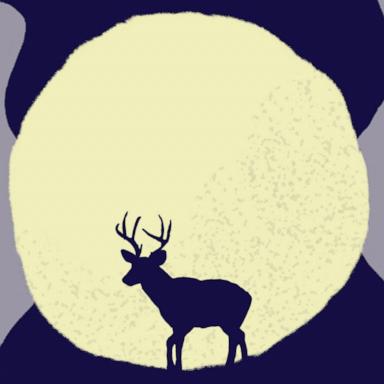


The last full supermoon of 2025, known as the cold moon, illuminated the late-autumn sky on Thursday, Dec. 4.
Skywatchers in the Northern Hemisphere caught the supermoon when it rose in the east at sunset, and the moon was at its highest path and brightest around midnight, according to the U.S. Naval Observatory's Astronomical Applications Department.
See more details on Thursday night's moon here, via NASA's Daily Moon Guide.
NASA defines a supermoon as the occurrence "when a full moon coincides with the moon's closest approach to Earth in its elliptical orbit," which is also known as perigee.
Lunar perigee happens at about 226,000 miles from Earth every 27-day orbit period, according to NASA.
The agency notes that the term supermoon, though not an official astronomical term, describes, "a full Moon that comes within at least 90 percent of perigee."
Viewing a supermoon is special because they only occur three to four times a year, according to NASA.
Moons can earn a variety of monikers and nicknames, which are derived from "centuries of Native American, colonial, and European traditions," according to the Farmer's Almanac.
The cold moon -- as this December full moon is commonly referred to -- reflects the frigid season, the Farmer's Almanac explains.
"It is also known as the Long Night Moon (Mohican) because it rises during the longest nights of the year, near the winter solstice, and remains above the horizon for an extended period," the weather and farm authority states.
This was the last supermoon of the year and the third in a consecutive sequence, but there will be a fourth supermoon in this same celestial series in January 2026, according to NASA.