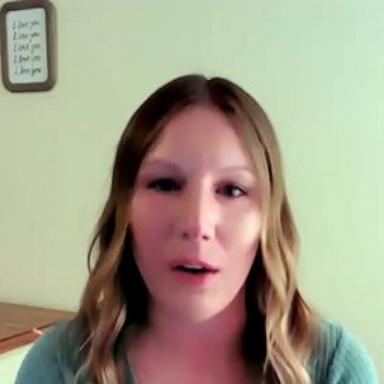


A new mom is searching for a living kidney donor nine months after giving birth and experiencing a rare and life-threatening pregnancy complication.
Soledad Guerrero, 36, told ABC News that although she's typically a "private" person, she wanted to share her personal health journey to encourage prospective moms to seek prenatal and postpartum care and to motivate others to get tested for and consider organ donation.
"I had the best pregnancy, and things just didn't happen like we were planning," Guerrero said of what she and her husband have been through.
The 36-year-old said she and her husband, who live near Seattle, Washington, underwent genetic testing and in vitro fertilization, or IVF, before welcoming their first child, a daughter, last October.
Guerrero said she and her husband never could have predicted she would subsequently experience a rare complication called pregnancy-associated hemolytic uremic syndrome, or p-aHUS.
"I didn't even have morning sickness. Like, I was just so perfect. I was swimming until the end. I was very active," Guerrero said, reflecting on her pregnancy. "This was just completely unexpected."
In late October, Guerrero said she went to the hospital for a planned induction but started developing blood clotting problems and ultimately needed an emergency cesarean section.
After surgery, doctors realized something was still wrong when Guerrero wasn't producing any urine. Guerrero said she ended up experiencing liver and kidney failure, and later, her liver recovered, but her kidney didn't, and doctors diagnosed her with p-aHUS.
According to the National Kidney Foundation, atypical hemolytic uremic syndrome, or aHUS, occurs when the complement system, a part of the immune system, becomes overactive and causes blood clotting that inhibits proper blood flow and drainage in different organs, particularly in the kidneys. One of the factors that may cause this type of aHUS is pregnancy, as denoted by p-aHUS.
Dr. Peter Chin-Hong, a professor of medicine at the University of California, San Francisco, who did not treat Guerrero, told ABC News it can be difficult for doctors to diagnose p-aHUS, because the condition is unusual and may also look like other conditions.
"It's very, very rare. There are many other causes of low platelets and anemia in pregnancy, and even in infectious diseases, there are microbes that can cause a very similar syndrome," Chin-Hong said. "It can be associated with pregnancy, which is a trigger to this immune issue, and it can mimic other conditions. So it can be quite challenging to diagnose."
Guerrero said doctors ruled out a genetic factor behind her p-aHUS but haven't been able to pinpoint what caused her to develop this rare condition.
One study published in the American Journal of Perinatology estimates that p-aHUS may occur in about 1 in 25,000 pregnancies.
Treatment options for p-aHUS can vary, but Chin-Hong said there are medications available for p-aHUS, called complement inhibitors, that target the overactive complement system.
In addition to medications and lifestyle changes, Guerrero said she started on dialysis after delivery, which she still requires, and which she described as "really rough."
Guerrero said as she waits to find a kidney donor, she is continuing with in-home peritoneal dialysis for at least eight hours at night, which she said makes it hard for her to get restful sleep.
In July, Guerrero said she took a big step: sharing her story in an online post and calling for others to get tested and consider kidney donation.
"Doing this is a big deal for me," Guerrero said about her decision to open up, adding, "If you were to look at me on the street and everything, you just wouldn't really think that anything's going on."
According to Guerrero, doctors told her a living kidney donor is the best option for her because she is more likely to find a match faster and the kidney will last longer. She said doctors have also told her she will likely need a second kidney transplant in the future.
Guerrero said that according to her doctors, if she can get a transplant, she will be able to resume her normal life afterward, including eating foods she has to currently avoid, swimming again and sleeping better.
She said she hopes to be there in the future for her young daughter, who she says is "doing really well" ahead of her first birthday.
"I hope that this allows people to see that just sometimes, bad things happen and people just need organs because you just had no control over a situation," she said.